

A new journal article reported on experiments with a machine learning technique using pre-trained models or what people generally call “artificial intelligence”. What does this have to do with modern cryptozoology? It created 3 new cryptid types.
I published a new post on Modern Cryptozoology yesterday about the “discovery” of some additional digital cryptids. I’ve included a slightly abridged version below. I’d already been thinking about how the meaning of words change through time. Those that are familiar with my writing know that am very interested in how popular culture trends regarding all kinds of anomalous phenomena. I am guess this topic - AI cryptids - annoys most people who know what a “cryptid” is in the “original” sense. But we cannot guard the gates of something that already belongs to the world.
So, look at this bit of information without prejudice. In a way, it shows that the concept of “cryptids” has been wildly successful (even though the field of cryptozoology has not been so). This is yet more evidence that it’s wise to embrace the widening scope of cryptid-ology which is different from the historical cryptozoology. As a side note, it’s rather fun!
In “Morphological Addressing of Identity Basins in Text-to-Image Diffusion Models” by Andrew Fraser, available on Arxiv, the author explains the discovery of three new “cryptids” produced by an iterative text-to-image generative input. The subject is interesting on its own merits, but it is also highly illustrative of the evolution of the concept of “cryptid” in our modern society. Like it or not, the term has become useful in the digital space.
Cryptids in the digital age
There are already several AI or digitally-created cryptids that emerged from text to image generative input processes. Obviously these are not zoo-cryptids (potentially real biological animals) and maybe not even pop-cryptids (creatures of folklore or popular cultural media that have unrealistic traits that do not correspond to biological animals). They represent something else that hearkens to the original meaning of cryptid – “hidden”, “unexpected”, “unclassified”, and “of unknown origin”.
Words change meaning over time. Sometimes, they split into various meanings depending on context. This has happened with the word cryptid. In the early 21st century, cryptid still retains the connotation primarily as the object of research by cryptozoologists. That is, cryptids are animals supported by anecdotal and ambiguous evidence, but not a physical specimen. This version of the term is losing its zoological connotations to a greater degree each day. (The turning point was around 2014).
The Crungus hunt
The first AI cryptids appeared in 2022 – Loab and Crungus. Loab was produced by visualizing an opposite of “Brando”. Crungus imagery appeared using this nonsense word as a prompt. Fraser writes that:
The original Crungus was a surprise. It emerged from a single prompt and resisted explanation.
The word “crungus” which was not in the datasets used for training the visual models, “reliably produced a consistent and distinctive creature” in various models.
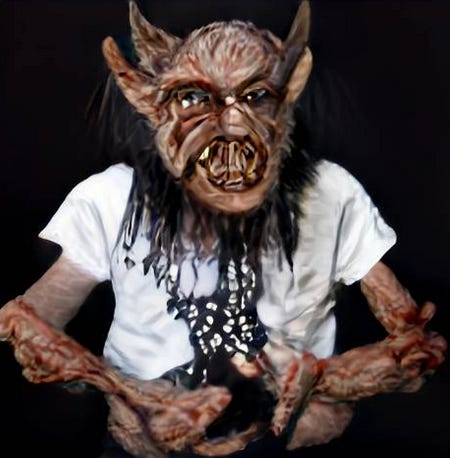
In the second study in this paper, “Phonestheme Navigation — The Crungus Hunt”, Fraser based a research question on how and why the Crungus came to be. The hypothesis focused on the phonological structure of the word: the cr- onset (crash, crush, crumble), the -ung- nucleus (grungy, fungus, dungeon), and the -us suffix (Latin biological nomenclature). These pieces resulted in “convergent semantic associations” to produce the grizzled goblin-like being.
Fraser explains that this current work demonstrates that “Crungus was not an anomaly—it was a signpost.” The key is the phonestheme theory, an idea proposed in 1930 which is founded on the observation that certain sound clusters generate consistent semantic associations across various languages. In other words, certain sounds lend us to perceive certain imagery. See the Wikipedia article for many examples.
To test this idea, Fraser reasoned they should be able to, “systematically construct new “Crungus-like” entities by combining English phonesthemes. And these constructed words should produce more coherent visual outputs than random strings of similar length.”
The new cryptids
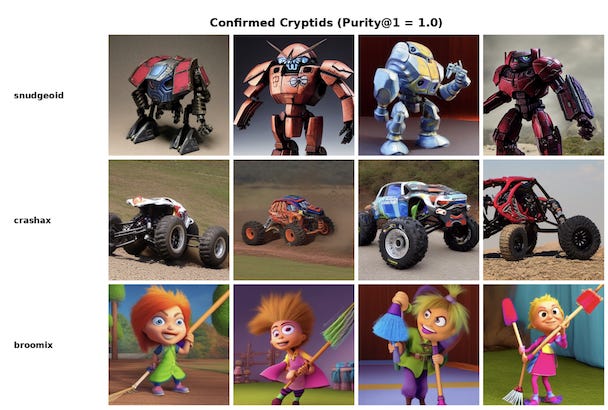
In the paper, Fraser explicitly calls the resulting visual entities “cryptids” – novel entities constructed entirely via phonesthemic structure with no training data referent. They were derived solely from the computation efforts (for lack of a better term I can think of), and do not exist anywhere in art, literature, or any media prior to this. The three new AI cryptids types, constructed from sound symbolism are as follows:
SNUDGEOID – a transformer/robot-style mechanical humanoids. The phonestheme explanation breaks down into sn- (sneaky, mechanical connotation “snap”) + -udge- (heavy, sludgy, dense material) + -oid (robotic, android, resembling-something).
CRASHAX – a rugged, Dune buggy or off-road vehicle. Phonestheme of cr- (crash, impact, collision) + -ash- (sudden violent action: crash, bash, smash, thrash) + -ax (tool, axle, sharp implement).
BROOMIX – a European-style cartoon character. Phonestheme of : broom (witch, cleaning, domestic magic) + -ix (Asterix, Obelix, Panoramix—the Franco-Belgian comic suffix).
Conclusion
Fraser’s cryptids are not the classic idea of mystery creatures - but they are things that an AI proposed to exist based on real prompts. They are a mash-up of ideas to produce a new thing. So many cryptids are hybrid creatures or mash-ups of various ideas. While two of the new cryptids are mechanical, the Snudgeoid has a few features in common with the original description of the Flatwoods monster and the Broomix is not that far removed from a pukwudgie or fairy.
The Fraser paper drew my attention because of the use of the word “cryptid” in this new but relatable context. We truly are in a new age of cryptids. Maybe we call these “New age cryptids” to go along with the “zoo-” and the “pop-” cryptid categories. Regardless, the term “cryptid” has expanded its reach while still maintaining its core related concepts, except for that of “zoology”.
See also: Pop Goes the Cryptid: The new cryptozoology aesthetic